
Political freedom is a prerequisite of our personal responsibility, our humanity. Any attempt to take a step towards a better world, a better future.
from “All Life is Problem Solving” by Karl Popper
Politics has became such a matter of priority that can not be leaved to a handful of politicians!
Ahmet Arslan, Introduction to Philosophy, pr.26, pg.166
People do not only want to see that those who make mistakes and those who are lazy being punished, but also they want to play a role on the distribution of justice even they know that they may pay for it!
Edward O. Wilson, The Social Conquest of Earth, pg.300
With Alexander the Great, Civilization met “despotism” the “easy-manage” tool of the East. This is the time when Citizenship died and Vassalage was born. Because the self-respecting and contributor citizens can only exist in sites like the ones in Ancient Greek era.
Will Durant, The Story of Civilization, vol.2, The Life of Greece, pr.23, pg.538-553
Power tends to corrupt and absolute power corrupts absolutely!
John Acton
By saying a ‘New System’, it is simply and purely intended to declare a “New-Generation” political system. This system can be thought as a ‘technological’ derivation of the Democracy which dominates our world as a fundamental governance mechanism since approximately 1 century.
New system, named as ‘Intelligent-Democracy‘ in order to indicate its inheritance and perspective clearly, is somehow shaped like literally well-known systems classified in ‘Direct Democracy’ category. So, it still comprises the self-management competence of the public like in Democracy, but not exactly in the way of today’s totally ‘Representative’ approach.
It is designed to be able to collect the opinion of public (one-by-one) for each decision it has to make (even micro ones if necessary) with the help of cutting-edge information based technologies. So, it can be briefly said that technology is going to be used as a tool in this new system in order to empower public’s domination on Representatives.
The necessity of citizen intervention to government’s activities will be determined by public itself in contrast to today’s approach where Representatives hold the power of deciding whether to ask citizens opinion for a specific decision or not in their hands.
With developing technologies, citizens will grasp the chance of monitoring and controlling the activities of government in a more transparent, dominant and real-time way and able to get the chance of pulling the decision making process down to their Levels of Determination (Figure-1). This kind of a suggestion of ‘Nation-wide Referendum’ mechanism does not has to be as restrictive and cumbersome as what Jean Jacques Rousseau postulated first time in his famous book ‘The Social Contract, 1762’ with the help of new digital environment and technological infrastructure we have created.
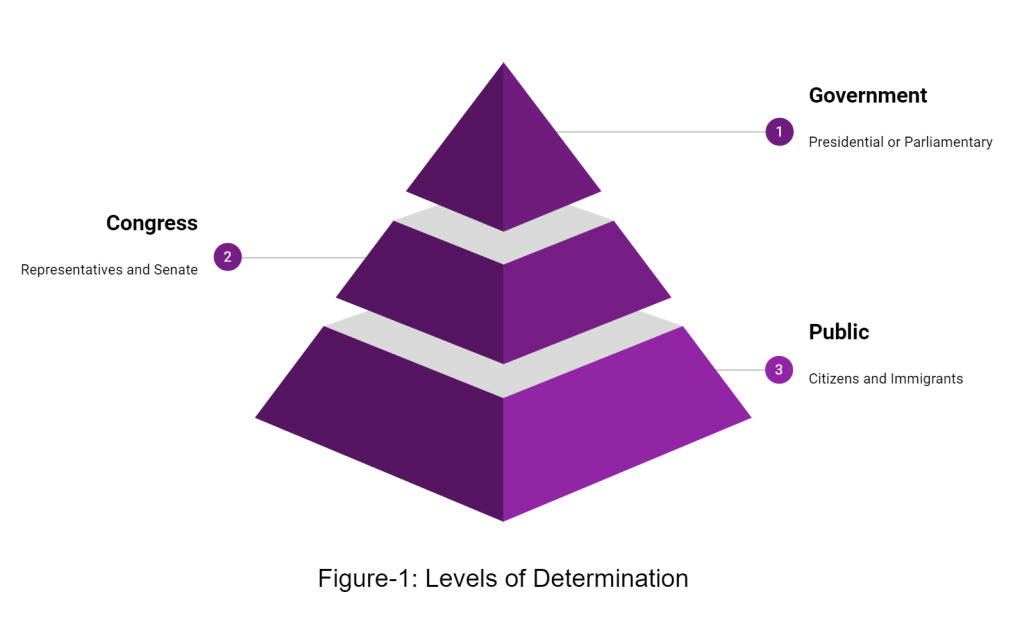
In the aspect of ‘Division of Power’, citizens are going to be able to take the role of Legislative Body only. So, the Judicial Authority will keep its mastery even on public based decisions and is going to be responsible for warning the public about possible discordance with fundamental human rights and/or global-wide contracts.
In 1961, Simon Ramo firstly discussed the possibility of many people being connected together through the computers. He said, “It is a degree of citizen participation unthinkable today.”. But today, after 60 years it should be thinkable and even applicable in some aspects of today’s digital life.
The sustainability and reliability of the new system will directly depend on new cutting-edge technologies which are already at the center of our lives and spreading out like a wildfire. They can be listed and described in summarized way as below:
- Blockchain (Cryptography based Distributed Settlement Protocol)
- IoT (Data collection and transmission with interrelated device network without requiring human interruption)
- Big Data (Platforms and architectures helping us to manage zettabyte amount of floating or batch data)
- Data Science (Algorithms helping us to analyze data, make anticipations/inferences and gather insights from it)
- Network Science (Methodologies helping us to find out relations, patterns and clusters in nonlinear/complex social networks)
Aforementioned technologies will be helpful for sharing the all necessary and available information with decision makers (citizens) without making a discrimination on them. This property represents the ‘Open’ness perspective of the new system being proposed. Their beneficial usages are detailed and exemplified in the related tabs on the main menu of this website.
It is a common thought that these technologies will change our style of living in the blink of an eye and will definitely shape the future of humanity. It is highly expected that the most concrete examples of those disruptive changes will show up in field of Politics which is the core mechanism of our society.
If we admit that the society we have created in thousands of years is the main building block of our species and the most complex system that human kind ever developed, then running it in a sustainable way must be the leading concern of all. Not for only us, also for the sake of the environment we live.
After thinking about the occurrences that we have terrifyingly observed/experienced only in last decade:
- Ecological Catastrophes (climate change, extinction of species, fatal hurricanes, pollution in air and oceans, etc.),
- Political Catastrophes (2016 election of USA, increment of dictatorships, coups and uprisings, Brexit, foreign worker suspensions, etc.)
- Financial Catastrophes (growing income inequality, 2008 sub-prime mortgage crisis, unfortunate QE programs, stagflation, currency wars, etc.)
- Health Catastrophes (pandemics, obesity leads off starvation, increasing number of malaria deaths, antimicrobial resistance, etc.)
- Humanity Catastrophes (endless wars in Middle East, migration of millions of Syrians, death for thousands of Yemeni people, nuclear tensions etc.)
which are damaging the sustainability of our society, it would not be a hard-to-reach conclusion that the system (society) we are living in does not seem to has enough longevity since it start to destroy itself by defecting and poisoning the community and environment we are all living in.
We can even see some extreme examples of such kind of frightening self-destruction attempts of our species in the short history. For instance, even in well/educated developed countries, citizens can fall in a situation of ‘Eclipse of Reason’ and collectively decide to give all their political competence to a delirious dictator (Hitler) who was so close to achieve his maniacal goals. Worse than that, those people who were in full confidence with the elected manipulator can merely recognize those terrible circumstances they had created after experiencing all negative effects. This kind of events mainly occur due to the systematic manipulation of society by using the asymmetry of information and post-truth consecrations.
Manipulation of societies still keeps its popularity. The asymmetry of information between the sides of Democracy (citizens and rulers) and utilization of post-truth posts via social media (thanks to 2016-President of United States!) have the potential to reduce the town of civilization to ashes!
So, it can be postulated as a general hypothesis that being able to make accurate and appropriate decisions while managing the societies is directly related to having totally transparent and interactive platform where participants have direct influence and authority on.
This ‘New System’ being proposed is all about how we can build and maintain such kind of a platform in a fair, efficient and open way.
The new system persistently will try to perpetuate the basic human rights bestowed by French Revolution as a legacy of Democracy, such as freedom, equality and more illustrated in Figure-2 below. Those are going to be the ones that their existence/necessities can never to be negotiated and even debated in the desired full-transparent, highly-sensitive and full-participated platform being recommended.

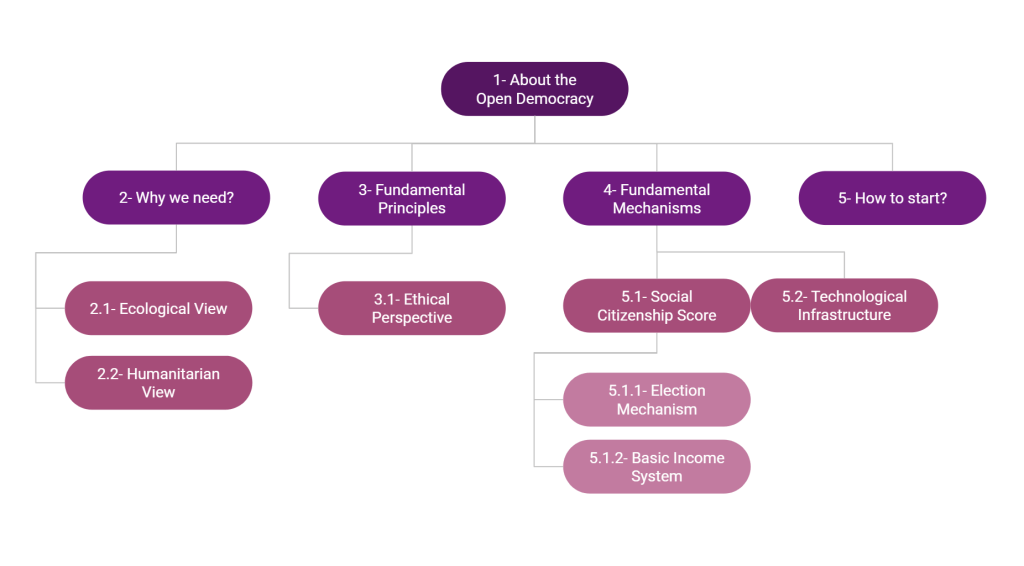
An index and a diagram for reading the remaining contents of this site is given below in order to guide you while getting know the proposed new political system and help you to capture what it really constitutes and offers.
Reading Index of Intelligent-Democracy website:
- About the New System
- Why we need it?
- Fundamental Principles
- Fundamental Mechanisms
- Social Citizenship Score
- New Election Mechanism
- Basic Income System
- Utilized Disruptive Technologies
- How to start?
 IntelligentDemocracyProject